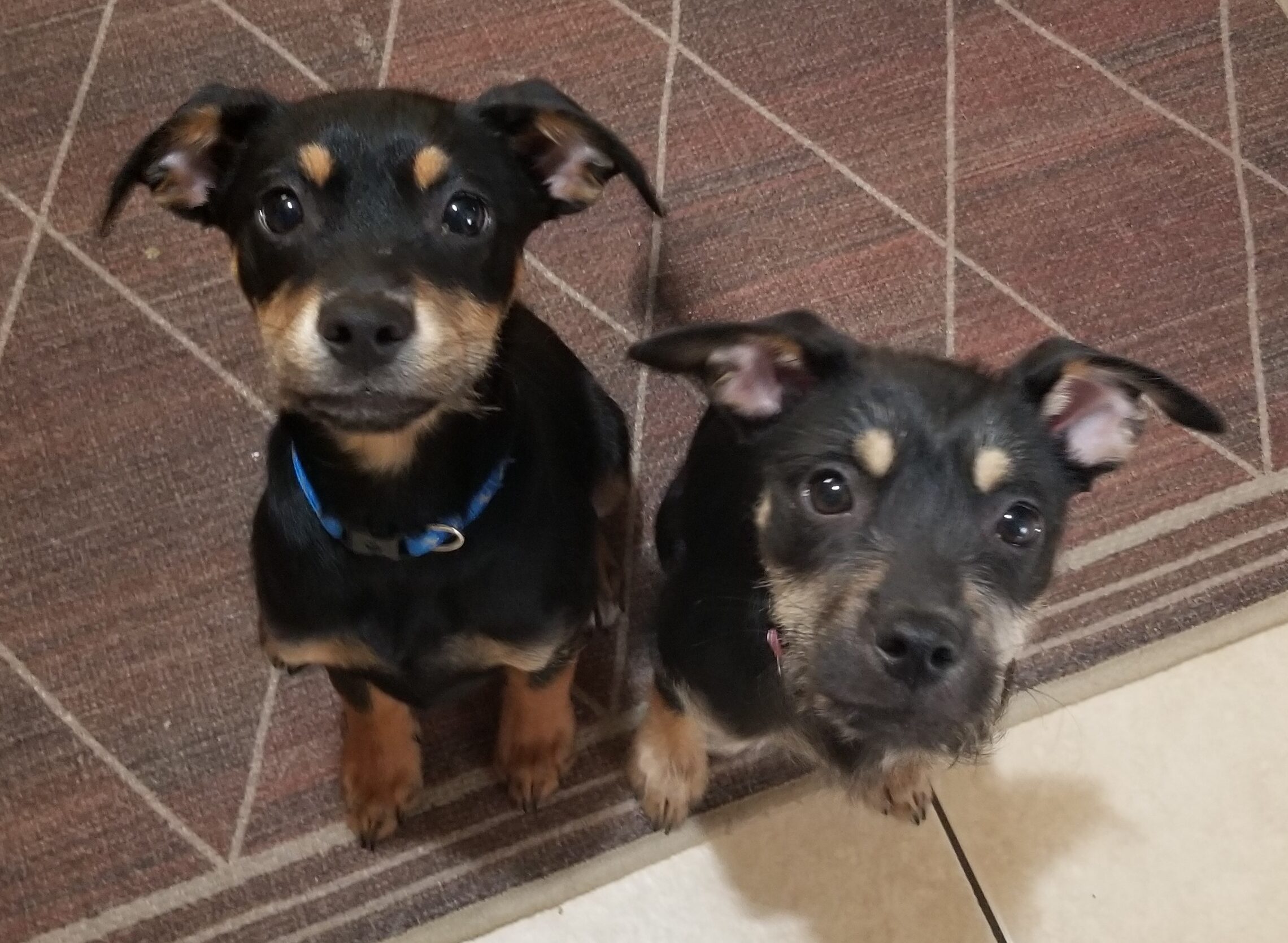
Eye Contact: The “Do”s and “Don’t”s – Part I
Eye contact can be a powerful thing. With humans, it can be a sign of respect and confidence. In animals, it can be a sign of confrontation.
When it comes to training dogs, this is one of the first behaviors I like to teach. After all, if a dog is looking at you, he/she isn’t looking at the squirrel that just ran across the road and you know you have his/her attention. I don’t do this with cats because, let’s face it, cats have no problem with staring.
So how can you get your dog’s eye contact so you can communicate what you want his/her action to be? After all, you don’t want to appear to be confrontational and you don’t want to get into a staring contest (although that can be fun sometimes.)
Well, it’s actually much easier than you think; however, you will have to pay attention to body language (yours and your dog’s) and timing. Here are some tips to perfect the focused eye contact.
- Choose a word or two-word phrase to use as an instant reward. A happy sounding “yes” will usually suffice.
- Pick a location where there is minimal distraction. Eventually you can work your way up to practicing when that pesky squirrel tries to derail your work, but for now you need to set you and your dog up for success.
- Casually look at your dog. It’s important that this is done when you are in a good or calm mood. The “mom look” works on dogs the same way it works on kids that are about to be in trouble so you want to abstain from this training if the dog did something unacceptable.
- When your dog looks at your eyes, respond with your reward phrase. The look does not have to be a stare or even a specific time limit. The reward phrase needs to be instantaneous and can be followed by positively interacting with the dog if the dog presents himself/herself to you.
- When the dog looks away, you can do this again. Keep repeating this over and over and your dog should begin to offer eye contact more often and for longer periods.
When your dog is pretty proficient, you can move to the next location with one or two distractions (inside the house next to a window, next to another person in the room, etc.) It is important to remember that dogs do not generalize well so what they learn in your living room may not work in the back yard right away.
So now that you know how to work on developing the focused eye contact, here are some “dos” and “don’ts”
DO:
– Start slowly with low expectations.
– Have the dog work with one individual at a time.
– Encourage everyone in the household to work with the dog using the same technique AND same reward phrase.
– Pay attention to your body language. If you move or flinch, the dog will be more focused on what you are doing rather than giving you eye contact.
DON’T:
– Force the dog to look at you. This will derail your attempts.
– Encourage the dog to look at you by making a noise. This will come later, but you want the dog to know the action first before tying it to a command, sound, or gesture.
– Reward the dog if time has passed. If your dog glances at you and then looks away before you are able to give the reward phrase, you may be rewarding a different behavior.
– Use treats in the very beginning. Like giving a cue, the treats will come later. Having a treat ready in your hand can cause the dog to focus on your hand and not your eyes. You especially do not want to give the dog something from your dinner plate or snack – otherwise you will start to encourage begging, which is not the point of this exercise.
Work on these actions randomly throughout the day, every day. Once your dog is giving you good eye contact on a regular basis and you can keep his/her focus for at least 3 to 5 seconds, you can move onto part II in this series.
Questions? Drop me a message in the comments below.
See you next time! – Grace
Leave a Reply